If your Vaillant ecoTEC has stopped and the pressure gauge is low, topping it up is usually a five-minute job you can do yourself. Most Vaillant boilers use a filling loop under the boiler, and some older combis use a filling key. Here’s how to do both, and when to call us instead.
At a glance
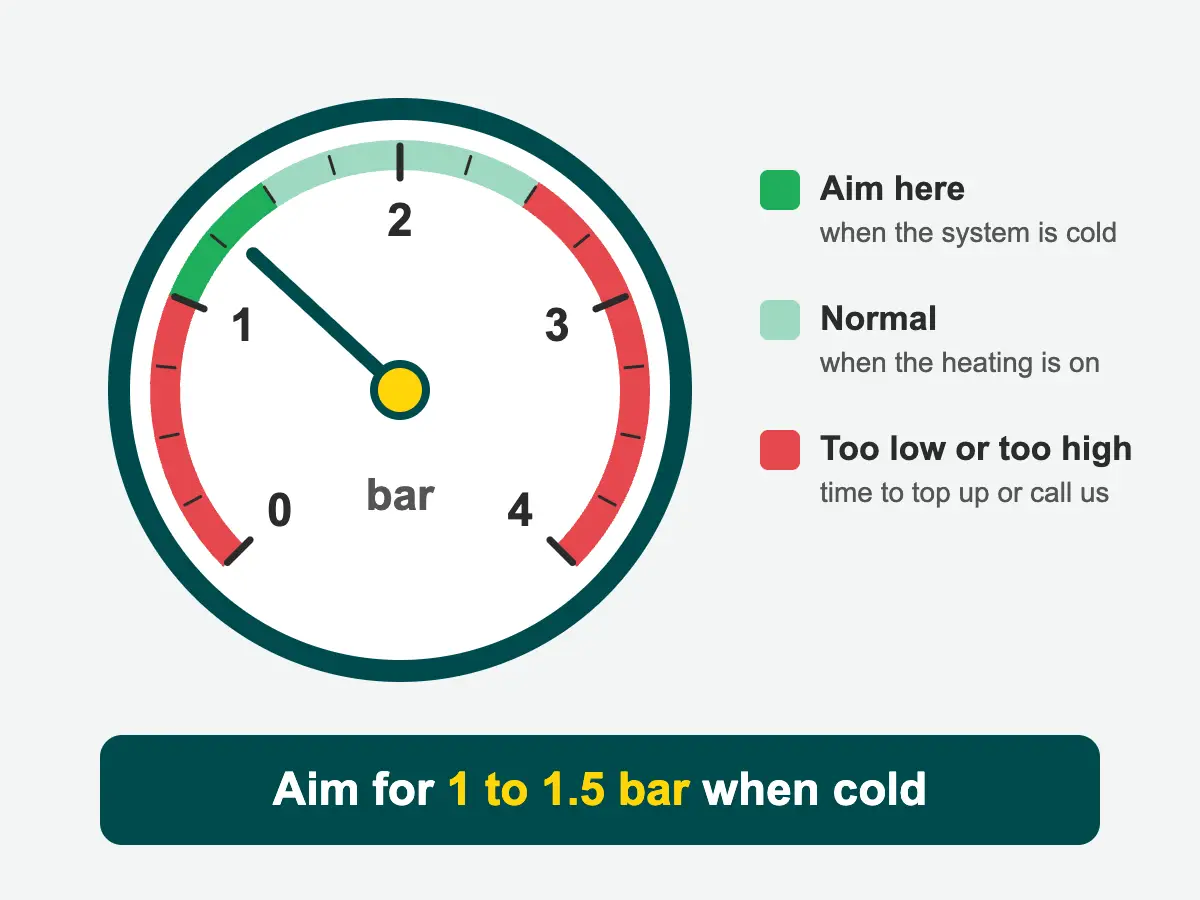
- Aim for: 1 to 1.5 bar when the system is cold
- Time needed: about 5 minutes
- You'll need: an old towel, and possibly a flat-head screwdriver
- Call us if: you're topping up more than once or twice a year
Before you start
- Turn the heating off and let the system cool down.
- Put an old towel under the boiler to catch any drips.
- Have your user guide handy if you've got it.
- Never take the front cover off your boiler. Anything inside it is a job for a Gas Safe engineer.
Check the pressure and find your filling controls
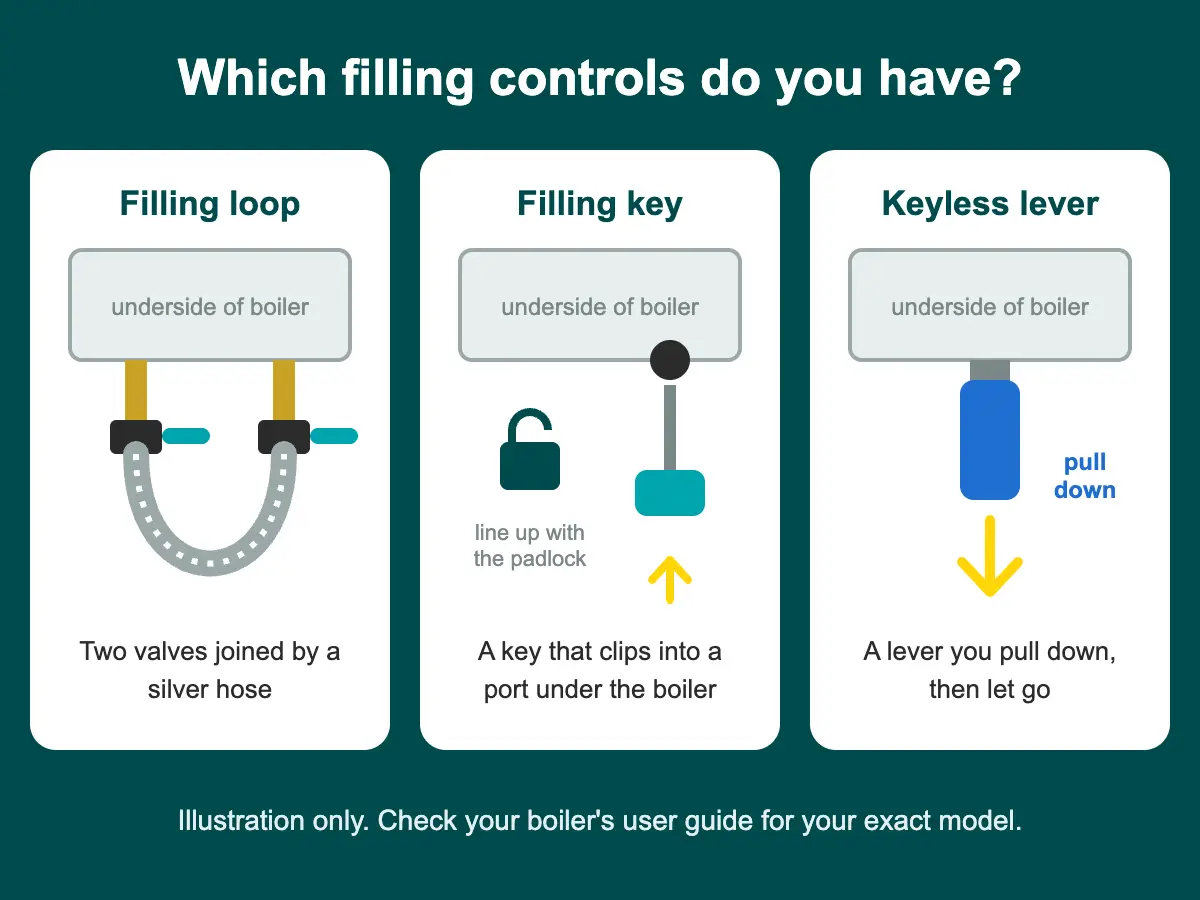
Check the pressure on the boiler’s gauge or display. If it’s below 1 bar, it needs topping up. Then look under the boiler for the filling loop: a flexible hose or lever, usually black or silver, connecting two valves. On some models it sits behind a panel, so check your user guide if you can’t see it.
How to top up a Vaillant boiler
Using the filling loop
This is the method for most Vaillant ecoTEC boilers.
- Turn the boiler off and let the system cool down.
- Check the filling loop is securely attached at both ends.
- Open the isolation valve by turning it anticlockwise until the line on it lines up with the pipe. A flat-head screwdriver usually works.
- Open the handle valve anticlockwise to let water in, and watch the pressure gauge.
- Stop at 1 to 1.5 bar, or the level in your user guide.
- Close the handle valve first, then the isolation valve, both clockwise.
- If your filling loop is detachable, remove it. Then turn the boiler back on.
Older combis with a filling key
Some older Vaillant combis use a filling key instead of a loop.
- Turn the boiler off and let it cool.
- Put the filling key into the keyhole under the boiler and unlock it.
- Turn the valve next to the key until water starts to flow. You may need a spanner.
- Watch the gauge until it reaches the level in your user guide.
- Close the valve securely, remove the key and turn the boiler back on.
Afterwards
- Turn the boiler back on. If it's still showing a fault, press the reset button.
- Run the heating and check the gauge again. It's normal for the pressure to rise a little while the heating's on.
- If you've just bled your radiators, check the pressure again, as bleeding lets pressure out.
Pressure keeps dropping?
Topping up once or twice a year is normal. Stop and get in touch if:
- You're topping up every month or more often
- The pressure drops again soon after topping up
- The pressure keeps rising after you've closed the valves
- The gauge reads zero or won't rise at all
- You can see water leaking from the boiler, pipes or radiators
If the pressure drops again soon after you’ve topped up, there’s likely a leak or a fault with the pressure relief valve. Don’t keep topping up, as that can cause more damage. Give us a call instead.
Need a hand?
Can't find your filling controls?
Send us a photo of the underside of your boiler on WhatsApp and we’ll let you know what you’re looking at. If the pressure won’t stay up, we’ll get you booked in.
Vaillant boiler pressure FAQs
Around 1 to 1.5 bar when the system is cold. It can rise a little when the heating is on, which is normal.
Underneath the boiler, connecting two valves. It's a flexible hose or lever, usually black or silver. On some models it sits behind a panel, so check your user guide.
Yes. It's a simple job you can do yourself, as long as you only use the filling controls you can clearly identify and never take the front cover off the boiler.
Bleeding radiators lets some pressure out, which is normal. If it keeps dropping on its own, there may be a small leak or a faulty pressure relief valve, so get in touch.